
High food prices caused by the war in Ukraine will last for at least two years, even if the crisis is resolved at Friday’s Berlin summit, western officials have said.
Senior politicians, including the US Secretary of State Anthony Blinken, will arrive in the German capital in an attempt to avoid an international food shortage caused by Russia’s blockade of Ukraine grain.
“If tomorrow the war was over, we are still looking at a two-year high of prices globally,” a western official told a media briefing.
The United Nations is also keen to find a solution, with talks continuing to persuade Russia to allow safe passage of freighters from Black Sea ports, where 25 million tonnes of supplies are currently bottled up.
The official said: “Discussions are being had in all the relevant UN bodies and with food being a weapon of war, the agricultural organisation of the UN is one of the main forums where this is happening. This is a geopolitical war going right across the UN membership.”
Friday’s food conference in Berlin will bring together the UN, the G7 and partner countries, philanthropic donors and some of the nations most affected by the hunger crisis. The talks are meant to pool global efforts, feed into this weekend’s G7 summit and “inspire other decision-making bodies” such as the European Union and G20, the German government said.
The US said it would use the talks to mobilise donations and seek solutions to the food crisis arising from the war between two of the world’s main agricultural producers. It said climate change and supply chain problems which have hampered the world economy since it began to emerge from the pandemic were exacerbating the global food problem.
Talks between the British Foreign Secretary Liz Truss and her Turkish counterpart Mesut Cavusoglu on Thursday were geared towards creating safe passage for commercial vessels so that grain exports could resume.
Concerns remain that conditions in poorer parts of Africa will soon begin to deteriorate, as a substantial amount of its food and fertiliser usually comes from Ukraine.

“Clearly, food is a huge issue for Africa and the longer the blockade continues, the longer we're in this situation and the more difficult it is for those countries that are directly affected,” the source said.
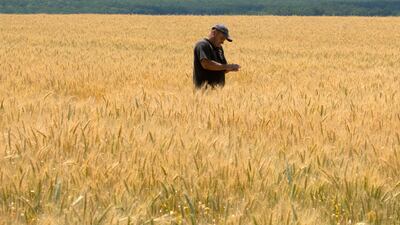
The first Ukraine harvest is due in two weeks but with no additional room for grain and wheat storage, the food must be exported as soon as possible.
“There is still going to be an impact on world food supply from Ukraine for an extended period as a result of the war and as long as the war continues,” the official said.
“The wheat harvest will be here in a couple of weeks, then other forms of grain will start arriving through August and September."
The official said stock could not be allowed to exceed storage capacity and issued a warning that "grain does go off even if it's stored".
Mr Blinken is expected to attend the food talks in person before joining President Joe Biden at the G7 meeting in the south of Germany. Countries will also be invited to join the Global Alliance for Food Security established at a meeting of G7 development ministers last month.

